NATIONAL
Union representation grows in 2025
New data from the Bureau of Labor Statistics shows working people continue to claim their power in unions despite obstacles
WASHINGTON D.C. (February 20, 2025) — In a reversal from prior years, union density among wage and salary workers grew in 2025, with 11.2% of U.S. workers covered by a union contract. That’s according to the latest data from the Bureau of Labor Statistics, which tracks changes in union membership and density year over year.
With 463,000 new members in 2025, 16.5 million workers now belong to a union, the highest number in 16 years. This membership growth comes as billionaire-backed politicians in D.C. seek to erode workers’ rights and undermine collective bargaining. And yet, nearly half of all union growth came from Southern states, where right to work laws have suppressed worker power for generations. Despite the Trump administration’s efforts to strip federal workers of collective bargaining rights, union density among federal workers actually grew to over 31%—the largest single-year increase since 2011. In line with the national trend, Washington state saw an increase in union density between 2024 and 2025, with union representation growing to 19.4%, a gain of roughly 54,000 workers.
“The numbers tell the story: even as the federal administration works to chip away at workers’ rights and suppress organizing, union membership is growing,” said Washington State Labor Council President April Sims, reacting to BLS data. “That growth proves a simple truth—working people know that nothing can stop us when we unite in union. Workers are claiming their power, forming and joining unions to secure better conditions and a real voice on the job.”
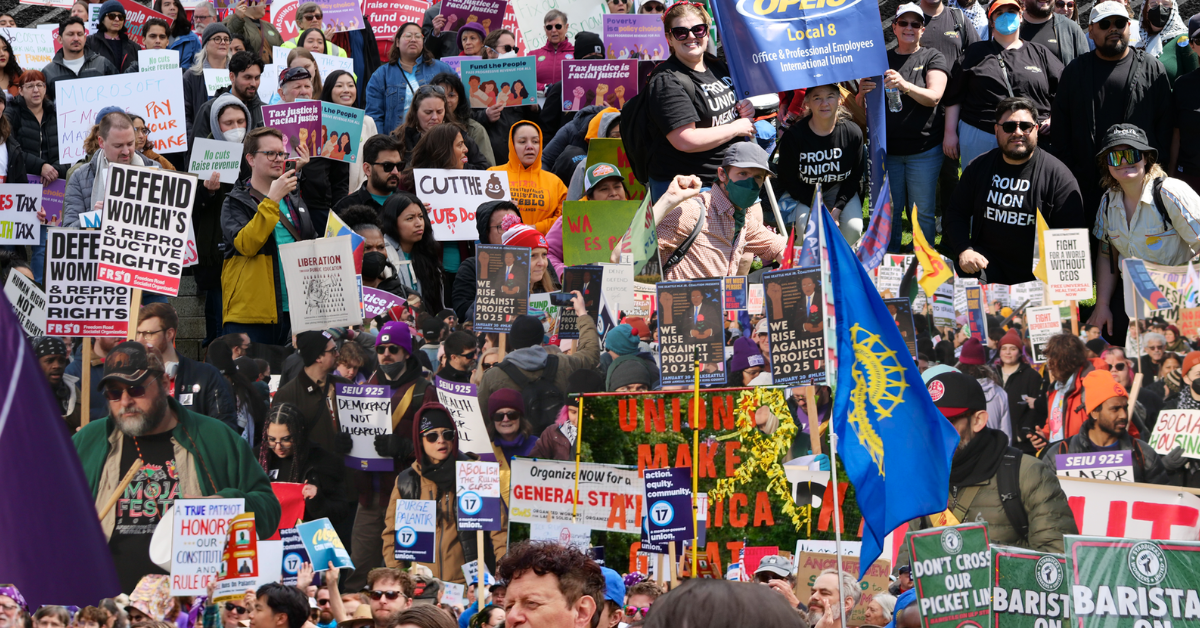

Working people desiring a union isn’t news — nearly 70% of people in the U.S. support unions. But growth is noteworthy, as decades of policies that undercut worker power have made forming and joining unions much more difficult. In this context, data indicating union growth is a testament to workers’ sheer determination and years of sustained organizing to overcome the obstacles in front of them.
“Billionaire bosses and union-busting politicians have tried to throw the kitchen sink at working people and their unions—slashing our jobs and rigging the rules to scare us out of organizing— but they are failing,” said AFL-CIO President Liz Shuler.
With an affordability crisis putting pressure on pocketbooks, working people see union membership as a path to economic security. On average, workers covered by a union contract earn nearly 13% more than comparable nonunion workers. And even more people say they’d join a union if they had the chance, indicating that working people know unions are the best way to take control in an economic system that too often benefits the wealthy few at the expense of everyone else.
“Our movement is 16.5 million workers strong, but we know more than 50 million workers would join a union if they could,” Sims noted. “If our elected officials want to truly represent their constituents, they should take immediate action to expand and protect the right to organize a union and collectively bargain.”
Several pieces of state-level legislation expanding collective bargaining rights continue to advance in the final weeks of the legislative session. But locally or nationally, the message for elected officials is clear.
“Politicians face a clear mandate to stand up to union-busting bosses, whether they are in the corner office or the oval office,” Shuler said. “We call on Congress to pass the Protecting the Right to Organize (PRO) Act and the Public Service Freedom to Negotiate Act, and to reverse the single largest act of union-busting in American history by passing the Protect America’s Workforce Act in the Senate.”