STATE GOVERNMENT
‘Worker power is the strongest force in this state’
Highlights from the Washington State Labor Council’s 2026 Legislative Conference
OLYMPIA, WA (February 6, 2025) — Hundreds of union members descended on the State Capitol Thursday to advocate for legislation that puts working families in Washington first. Starting with a morning program featuring labor leaders and legislators, union members learned about pro-worker bills, gained perspective of legislators’ decision-making processes, and built community with one another.
WSLC President April Sims opened the legislative conference, speaking to the current moment and how critical — and righteous — it is for working people to engage in the work of the State Legislature.
“Moral clarity means understanding a simple truth: what is legal is not always right, and what is right is not always legal,” said Sims. “That truth is the reason the labor movement exists…there was a time when it was legal to enslave Black workers—to brutalize them, to separate families, to deny their humanity entirely. The law did not make these systems just. Our laws become more moral only when working people force them to change.”


WSLC President April Sims.
Sims continued: “Our goal is to correct power imbalances written into our laws. We are here to make what is moral, legal.”
State Representative Shaun Scott and State Senator Rebecca Saldaña (both D-Seattle) addressed the crowd. Saldaña, who announced in December that this would be her final session as a State Senator, has championed pro-worker legislation for a decade. Scott, while in only his second session, is quickly making a name for himself as an outspoken advocate for working families. Saldaña shared some highlights from her work as chair of the Senate’s Labor & Commerce committee, with both legislators speaking to the critical role union members play in shaping state policies to better serve working people — like expanding and protecting the right to organize and securing progressive revenue to fund critical public services.
“Nothing is going to happen in the state legislature without the grit and power of the labor movement behind it,” said Rep. Scott.

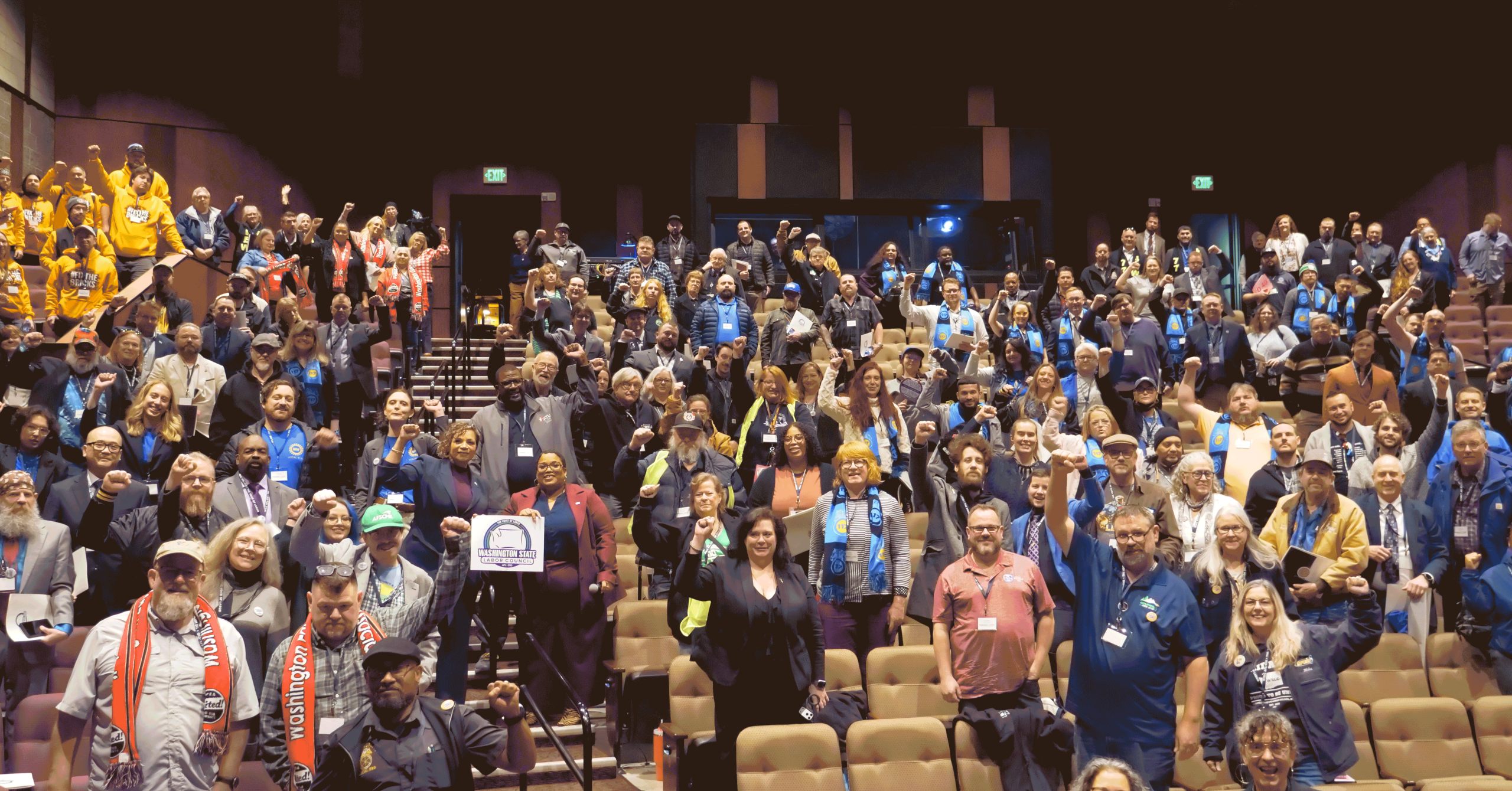
Some of the attendees of the 2026 WSLC Legislative Conference pose for a photo before heading to the Capitol to meet with legislators.
Bi-partisan support for pro-worker legislation
State Representatives Edwin Obras (D-SeaTac) and Sam Low (R-Lake Stevens) united for a legislator panel, facilitated by Deputy Government Affairs Director Carissa Larsen, detailing how they make decisions and their perspectives on the legislature’s work. Obras shared lessons learned from working with both the Driver’s Union and SEIU Local 6 to pass legislation protecting workers’ rights, including how powerful the big business lobby can be in opposing working people’s interests. Low shared a commitment to working on housing affordability, and that he is working to build understanding among the House Republican caucus about the key role organized labor plays in improving working conditions for all Washingtonians.
“I think labor should be [treated] how we treat firefighters,” said Low. “Everyone should be supportive, everyone should work on labor issues.”
He continued: “We are open minded on both sides of the aisle, but sometimes we don’t know what we don’t know.”
It’s clear Low and Obras share a mutual respect with one another and commitment to working across party lines — “There’s always a way to work together,” said Obras. Both legislators emphasized the importance of working people educating their legislators about their lives and needs, and explained that the working people who elected them are front of mind when making decisions in the legislature.
“You’ve got to remember who brought you here,” said Low.
Deep dive into labor’s priority legislation
Labor lobbyists joined WSLC Government Affairs Director John Traynor to detail several policies the entire labor movement is uniting to support. Dylan O’Connor (UFCW 3000) explained how a bill to ban surveillance pricing in grocery stores is designed to prevent massive grocery companies from nickel-and-diming working families. Khalil Hamiduddin (SEIU 6) spoke to the importance of the Immigrant Workers Protection Act, which requires employers to give workers notice if the federal government audits I-9 forms, providing opportunity for workers to ensure their legal authorization to work in the U.S. is in proper order.
Cassie Bordelon (Climate Jobs WA) covered a variety of bills that will expand transmission capacity, furthering the state’s climate resiliency goals and creating family-wage, union jobs statewide. And Matthew Hepner (Certified Electrial workers of WA) lifted up a bill to require behavioral and mental health training in apprenticeships, a bi-partisan policy intended to address the epidemic of substance misuse and deaths by suicide impacting building and construction trades workers. Hepner asked attendees to raise a hand if they know anyone who has struggled with mental health or substance use; nearly every hand went up.
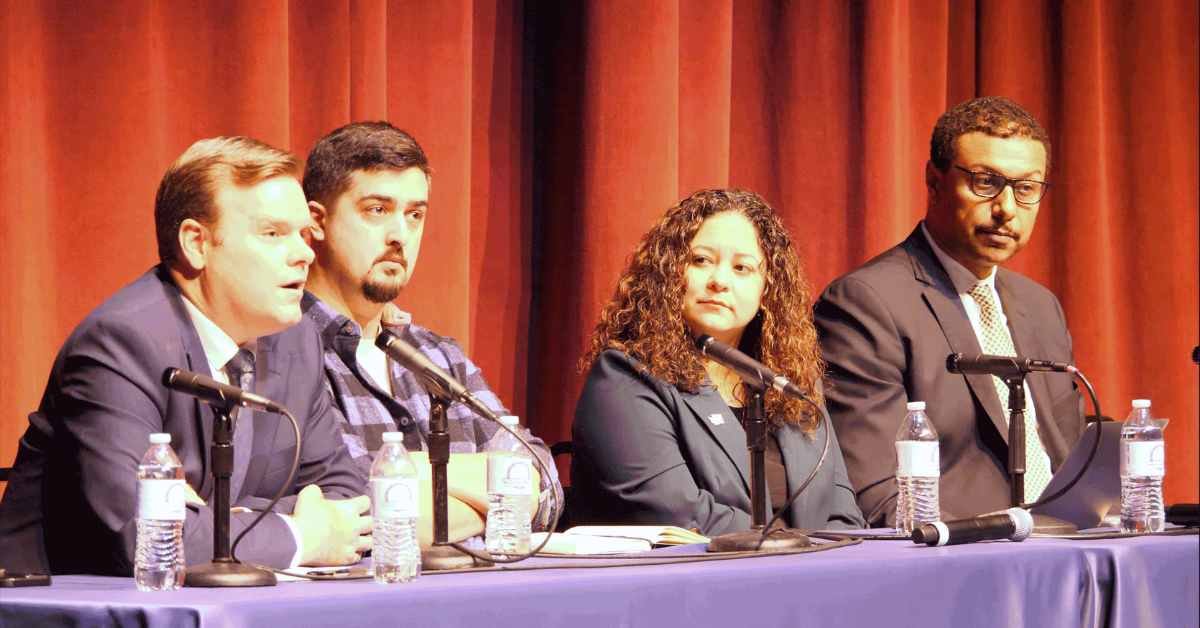
Panelists from left: Neil Hartman (UA), Rian Watt (Economic Opportunity Institute) , Nikki Gomez (WFSE), Djibril Diop (WEA).
Why taxing the rich matters to workers
Mental health was also a focus in a panel concerning the need for new, progressive revenue sources. Facilitated by WSLC Chief of Staff Joe Kendo, Djibril Diop (WEA), Nikki Gomez (WFSE), Neil Hartman (UA), and Rian Watt (Economic Opportunity Institute) shared the experiences of people deeply impacted by instability in state funding: educators, public employees, and building and construction trades workers. Each spoke to the impact stressors like job insecurity and limited funding for wages and other essentials impact the workers who work every day on behalf of Washingtonians.
Hartman shared that construction infrastructure investments reverberate beyond projects, buoying local businesses and communities. But with work slowing down or stopping altogether, both local economies are workers are hurting. Across the trades, about 10,000 skilled workers aren’t on projects. “Being out of work causes significant strain,” said Hartman.
Diop and Gomez both spoke about educators and public workers trying to do more with less, as wages aren’t keeping up with inflation and funding sources dry up. Both shared that workers are stressed about their mortgage and other bills, with some forced to take second jobs. From this perspective, requiring the ultrawealthy to pay their fair share to fund the services we all benefit from is a way Washington can address the mental health crisis visible in communities across the state.
Solidarity and celebration
While policy work was certainly the focus of the day, attendees also took a moment to honor long-time labor activist Kevin Allen. A member of WFSE who served a decade on the WSLC’s Executive Board representing the Coalition of Black Trade Unionists, Allen received a long standign ovation from the crowd as he took to the stage to be recognized for his years of service to the movement.
“Kevin has always been about the business of labor,” said Sims. “Not the spotlight, not the title—but the work.”
To close out the morning program, Secretary Treasurer Cherika Carter lead a rousing chant to fire up the crowd before union members headed to lobby legislators and staff about pro-worker policy, making sure the voice of labor was heard loud and clear.
In the words of President Sims: “Today, we remind elected officials who they answer to. We remind them that worker power is the strongest force in this state.”