ELECTION
5 takeaways from the union-made blue wave
Turns out, listening to workers — or heck, running them for office — is a successful electoral strategy
by SARAH TUCKER
(November 10, 2026) — Call it a blue tsunami or a red wipeout, the 2026 midterms saw voters dissatisfied with Trump and his regime deliver Democrats decisive control of Congress, with pro-worker candidates flipping state legislatures and governors’ mansions. In state after state, voters rejected MAGA policies, instead voting for candidates focused on lowering costs, growing good union jobs, protecting immigrant neighbors, fighting corruption, and combatting corporate greed. While the tea leaves are still being read — and counts in some races continue — it’s clear that in the ballot-box battle of workers versus billionaires, workers took the day.
That wasn’t a foregone conclusion. Nor was it a fluke. Tens of thousands of union members organized for this outcome, with lessons to be learned for how we keep beating billionaires and anti-worker politicians.
Capitalize on the union (vote) difference.
In basically every election, union members are more likely to vote than not-yet-union workers. This year, union voters made up at least 15% of the overall electorate, outpacing their share of the population. And it’s not just that union members turned out; it’s who they turned out for. “Exit polls showed union households voted 21 points more for Democrats than Republicans nationwide, shaping results that were decisive for control of Congress,” said AFL-CIO President Liz Shuler in a statement.

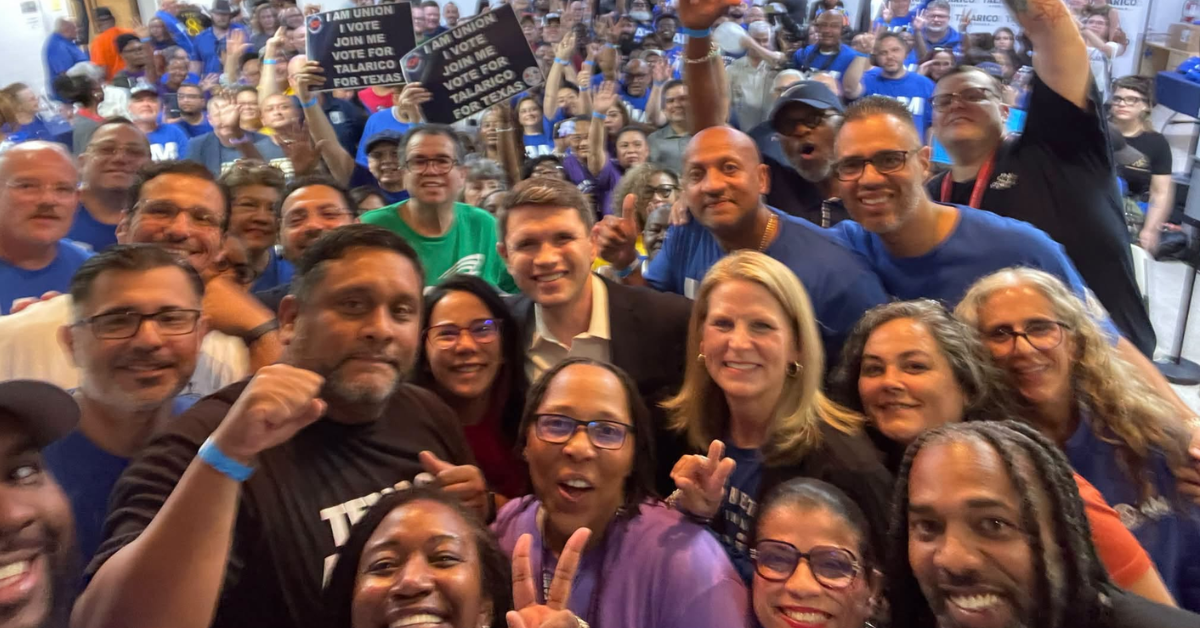
Texas AFL-CIO President Leonard Aguilar, Texas Senator-elect James Talarico, AFL-CIO President Liz Shuler and supporters. Photo: Texas AFL-CIO
Run union members for office.
More than 640 union members were elected to local, state, and federal offices this cycle. Some of the biggest names of the night — Gina Hinojosa and James Talarico in Texas, Abdul El-Sayed in Michigan, Troy Jackson in Maine, Sam Forstag in Montana, Brian Poindexter in Ohio — are all card carrying union members, per the AFL-CIO. In Washington state, two union members flipped Republican-held state house seats: Deken Letinich (LiUNA) in Southwest Washington and Renee Hernandez Greenfield (AFT) on the Kitsap and Key Peninsulas (WSLC Political Director Osta Davis breaks down Washington results in today’s edition of The STAND).
Union members are good candidates for a few reasons; they know how to organize, they’re plugged into their community, and they can talk about the price of gas and groceries without sounding like Lucille Bluth.
Run on worker issues.
Speaking of those issues: candidates won when they stayed laser-focused on fixing a broken economy that enriches billionaires while leaving working families to struggle. In Michigan, Abdul El-Sayed’s mantra, “getting money out of politics, money into your pocket, and medicare for all” drowned out the increasingly hysterical anti-Muslim hate bleating from his opponent. Confident in El-Sayed’s commitment to worker-first policy, the UAW and other unions went to the mat to get out the vote for him. In Ohio, Sherrod Brown stayed rooted in the pro-worker values that have guided him his whole political career, regaining his seat in the Senate. Farther east, the Maine AFL-CIO and aligned unions knocked on over 115,000 doors for Troy Jackson, a logger who cut his teeth pushing worker-first policy in the state legislature.
And while the race has yet to be called, Scott Colom is likely to win a Senate seat in Mississippi to become the first Black senator in the state since Reconstruction. In a state with the lowest voter turnout in the nation — virtually no early voting is possible and polls are only open from 7:00 a.m. to 7:00 p.m. on Election Day — Colom took his message directly to workers during their shifts at box stores, fast-food joints, and other low-paying gigs. Speaking of…
Don’t count out the South.
For years, labor organizers in the South have been telling the rest of the country not to overlook our siblings below the Mason Dixon line. While pundits may have written off the region, eagle-eyed readers of the Bureau of Labor Statistics annual report may remember a prescient data point: of union growth in 2025, nearly half of all new union members in the U.S. were in the South.
Growing union density in right to work states takes gritty, creative organizing. It builds a muscle labor was able to flex this election cycle to break the stranglehold an anti-worker Republican party has maintained for generations. And while a Supreme Court decision gutted the Voting Rights Act, Black voter turnout actually increased in states where data on voters’ race is collected, like Georgia and Mississippi. The South Carolina AFL-CIO credited a partnership between labor and faith groups over shared affordability goals for flipping a Senate seat not held by a Democrat since Strom Thurmond changed party affiliation in protest of the Civil Rights Act of 1964. Union volunteers in North Carolina knocked 84,000 doors, out-organizing gerrymandering to flip multiple congressional seats.
In Florida, Angie Nixon, a union organizer, came close to securing a Senate seat in a state the Democrats have largely given up on. The turnout her grassroots campaign generated paid off down-ballot, ending the Republican supermajority in the state house. Florida’s state legislature has been ground zero for anti-labor, anti-worker legislation pushed by out-of-state ideological extremists who’ve washed out elsewhere. Union members are out-organizing those laws, building momentum that will make Florida a state to watch in 2028 (Nixon has already stepped up to run again).
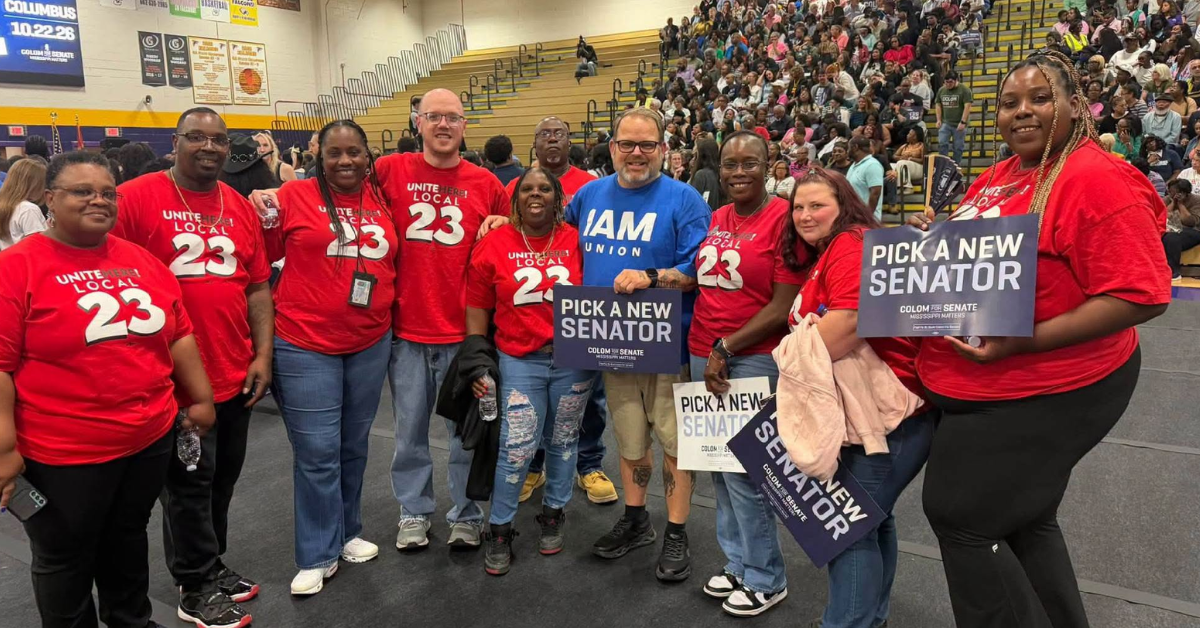
Union members rallying for Scott Colom in Mississippi. Photo: AFL-CIO
Out-organize billionaires and the politicians they own.
Of the many losers on Election Night, perhaps no one paid so high a financial cost as Elon Musk. The world’s first trillionaire spent half a billion dollars to elect Republicans, only to see his adopted home state of Texas go blue for the first time in a generation. He might as well have dropped those millions in the trunk of a Tesla and waited for it to spontaneously combust. And Texas voters didn’t just flip a Senate seat and a governorship. The Texas AFL-CIO reports union members knocked 50,000 doors and made 230,000 calls, flipping the state house and electing Democrats to every statewide office. Union membership in the state is at a 25-year high.
Nationwide, Republican legislators who gerrymandered districts to lock-in power for a party by and for billionaires saw those machiavellian schemes fail, picking up seats in just two of the 15 districts they’d tried to grab. Those gains were entirely washed out by losses in other districts in those same states. In fact, only California’s responsive redistricting worked; Democrats won all five redrawn districts.
While disgust at Trump’s policies absolutely influenced voters, these results weren’t guaranteed. Anger doesn’t necessarily translate into votes. Organizers had to tap into outrage, channeling voters towards action and away from apathy. Between Labor Day and Election Day, union volunteers talked to more than 14.9 million working people in battleground states, real conversations at front doors, on jobs sites, and over the phone.
That work may well have changed the trajectory of this country.
Working people have handed Democrats considerable power. The question now is what they’ll do with it.
Sarah Tucker is Communications Director for the Washington State Labor Council, AFL-CIO and Editor of The STAND. 
