NATIONAL
News, not slop
Unionized journalists at Politico won a landmark arbitration demonstrating how collective bargaining agreements protect workers from unethical AI in the workplace
WASHINGTON, D.C. (December 3, 2025) — Politico and E&E News journalists announced a major victory in arbitration this week, successfully arguing that Politico management violated the workers’ collective bargaining agreement by unilaterally introducing two artificial intelligence tools for news coverage without providing notice or bargaining over their implementation. Per the workers’ union–the PEN Guild, part of the Washington-Baltimore NewsGuild-CWA–it’s one of the first major arbitration cases concerning AI practices in journalism, setting a powerful precedent.
“This ruling is a clear affirmation that AI cannot be deployed as a shortcut around union rights, ethical journalism, or human judgment,” Unit Chair Ariel Wittenberg said in a statement. “This is a win for our members at POLITICO fighting to ensure that AI strengthens our newsroom rather than undermining it.”
Politico and E&E News journalists secured contract language governing how AI tools could be implemented in their first contract. Those collectively-bargained protections require the employer to give 60 days notice before introducing AI tools that substantially impact work or could lead to layoffs, engage in good-faith bargaining concerning those tools, ensure the tools meet Politico’s ethical standards, and require human oversight. The arbitrator ruled that management violated these contract terms twice, through AI-created live summaries of news with factual and style-book errors and an AI Report Builder that created inaccurate reports, citing journalists’ work, lacked any human review, and was riddled with errors. In both instances, management failed to notify the union or bargain over implementation of these tools.
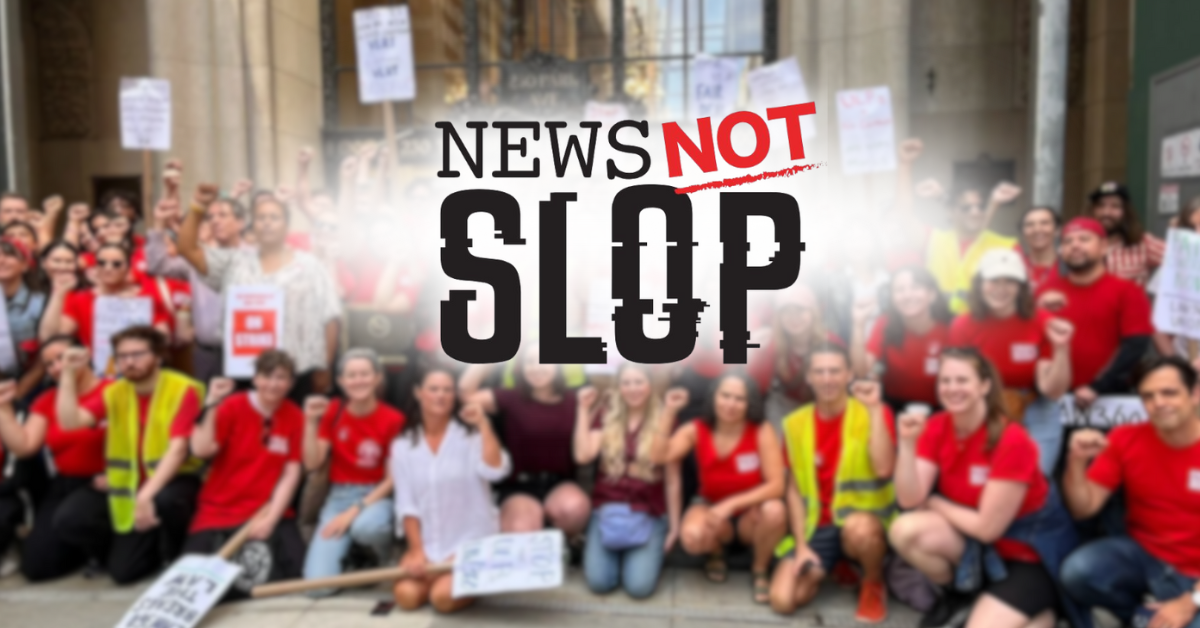
The NewsGuild-CWA has launched News, Not Slop, a campaign to call for accountability in the use of generative AI in newsrooms. Photo: NewsGuild-CWA
“This ruling affirms that employers cannot use emerging technology as an end-run around contractual obligations,” said Amos Laor, Washington-Baltimore News Guild General Counsel in a statement. “AI tools may be new, but the legal principles we secured in the agreement are not: management must provide notice, bargain with the union, and ensure that innovation does not come at the expense of workers’ rights or diminish their work. For journalists, issues of journalistic integrity are directly tied to their reputation, relationship with readers, and ability to perform their duties, and we view the protection of newsroom ethical standards as an integral part of their labor rights.”
The proliferation of AI slop — poor quality, inaccurate, misleading or just plain weird media — is a growing concern for both creative workers and the general public, from newspaper readers to TikTok users. It’s impacts are far-reaching, with the generative tech used to spread misinformation or heighten division, raising broad concerns about reliability and ethics.
“This decision makes it clear that unionized journalists are the ones fighting for accurate news when companies roll out AI spreading misinformation,” said NewsGuild-CWA President Jon Schleuss. “Journalists, by unionizing and demanding quality for their readers, are negotiating stronger ethics, accountability and actual humans producing the news. This ruling is a strong message to every media boss: AI must be implemented responsibly, transparently and through negotiation with journalists.”
Now, NewsGuild-CWA journalists have launched a campaign — News, Not Slop — calling for common-sense protections around artificial intelligence in media, fighting to ensure that AI slop and misinformation doesn’t erode the integrity and reliability of the news coverage we all rely on.
Supporters of ethical, human-made journalism can join the fight by signing their name to a petition targeting newsroom editors across North America.



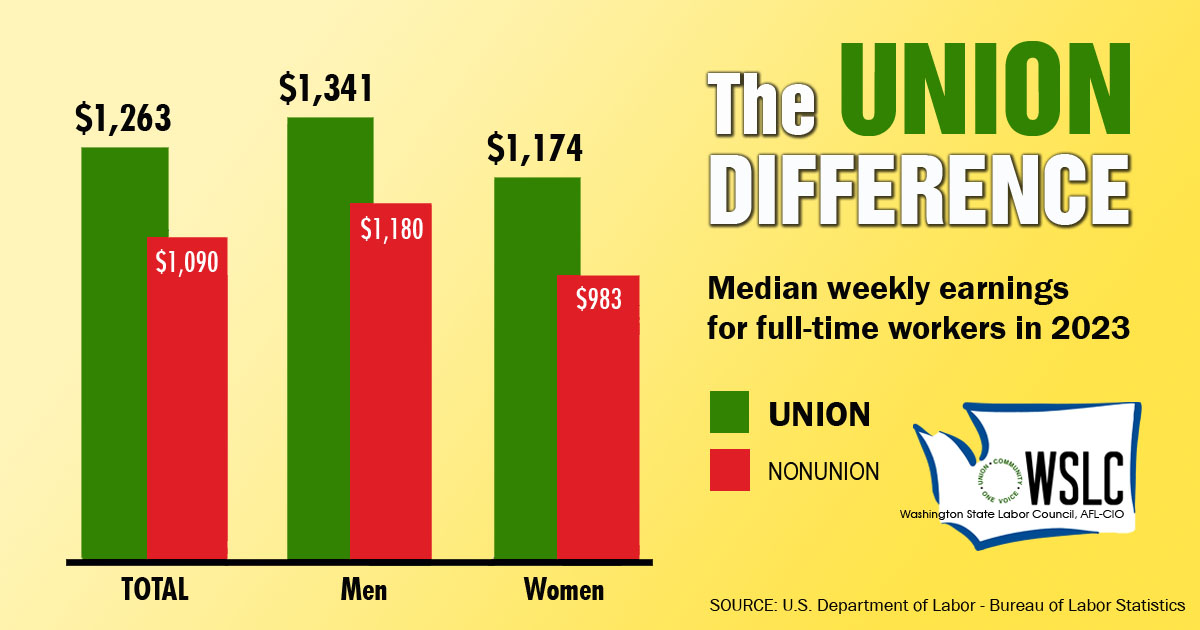
CHECK OUT THE UNION DIFFERENCE in Washington: higher wages, affordable health and dental care, job and retirement security.
FIND OUT HOW TO JOIN TOGETHER with your co-workers to negotiate for better wages, benefits, and a voice at work. Or go ahead and contact a union organizer today!