NATIONAL
‘This is a blatant attack on unions’
Defending the workers who safeguard the nation’s electrical grid, IBEW is challenging the Trump administration’s unlawful union-busting
WASHINGTON, D.C. (December 5, 2025) – Most people don’t think about electricity until the lights go out. But the system that powers homes, schools, grocery stores and banks depends on the labor of thousands of electrical workers who clock in every day to fix, maintain, and safeguard the hydroelectric infrastructure and high-voltage transmission lines that bring power to communities across the U.S.
That work is constant, essential, and notably, apolitical. Or at least it was.
Earlier this year, the President signed executive orders stripping collective bargaining rights from hundreds of thousands of federal workers – including those who keep the nation’s electrical system running – injecting politics into work vital to economic and national security. Now, local unions of the International Brotherhood of Electrical Workers are taking the Trump administration to court, arguing that these union-busting executive orders are both unlawful under federal law and illegal retaliation against the union’s constitutionally-protected political speech.
The lawsuit was filed in the U.S. District Court for the District of Columbia by the IBEW Government Coordinating Council-1 (GCC-1) and Local Unions 77, 283, 611, 640, 1002, 1245, 1759, 1959, and 2159 on behalf of more than a thousand federal electrical workers west of the Mississippi River.

The Grand Coulee Dam.
“These men and women are the backbone of America’s power infrastructure,” said Amanda Moore, GCC-1 Chair. “They restore power to the public after storms, maintain massive hydroelectric dams, and keep the grid running 24/7. Stripping them of a voice at work isn’t just illegal, it’s reckless.”
More than 180 workers represented by IBEW Local 77 at the Grand Coulee Dam and the Columbia Cascades basin in Yakima are among those impacted. Grand Coulee is the largest power station in the United States, powering millions of homes and businesses in the Pacific Northwest.
“Eliminating the bargaining rights of our represented Federal workers would lead to devastating impacts on their livelihood and families by stripping them of the ability to negotiate their wages and certain working conditions,” said David Garegnani, IBEW Local 77 Business Representative.
The lawsuit argues Executive Orders 14251 and 14343 unlawfully deprive federal electrical workers of their union rights for several reasons. First, the two executive orders in question cite two chapters of the United States Code to strip collective bargaining rights from federal workers, law that doesn’t apply to the electrical workers. Second, the Civil Service Reform Act, enacted by Congress in 1978, expressly limited the President’s authority to revoke collective bargaining rights for these workers, a move intended to protect them from exactly the kind of executive overreach and politicization exemplified by the President’s orders. The lawsuit argues these executive orders effectively defy a law passed by Congress, undermining fundamental structures of American democracy. And third, the IBEW locals argue that these executive orders are intentional retaliation aimed at punishing the union for its advocacy against anti-worker actions by the Trump administration, advocacy protected by the U.S. Constitution.

A high-voltage substation.
“President Trump’s actions are a targeted assault on federal workers’ rights and the rule of law,” said Brook Dooley, a Keker, Van Nest & Peters partner representing the IBEW Local Unions. “Congress explicitly protected the bargaining rights of these federal employees nearly 50 years ago. No president can erase those rights with the stroke of a pen.”
The union-busting executive orders make broad claims about national security to justify gutting collective bargaining rights. But for the electrical workers, the notion that workers having a voice in their working conditions is a threat to national security just doesn’t make sense.
“The right to collectively bargain has no direct threat to national security,” said Garegnani of IBEW Local 77. “This is a blatant attack on unions, and we will fight to protect what the IBEW has fought hard to win.”
Electrical workers continue to show up every day to keep the power on. But allowing federal workers’ working conditions to be subject to political whims raises questions about the long-term impacts on a system every community in the U.S. relies on.
“Losing union rights would result in a decrease of qualified workers in our region,” warns Garegnani. “When pay and working conditions are not to the IBEW standard, employees will find employment elsewhere.”



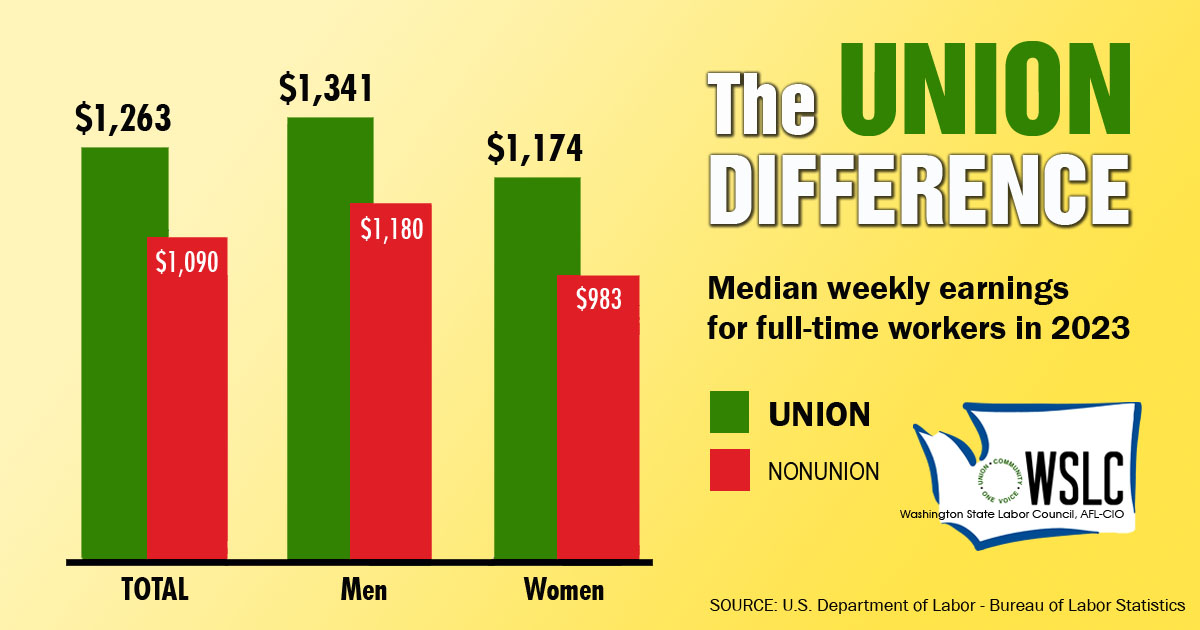
CHECK OUT THE UNION DIFFERENCE in Washington: higher wages, affordable health and dental care, job and retirement security.
FIND OUT HOW TO JOIN TOGETHER with your co-workers to negotiate for better wages, benefits, and a voice at work. Or go ahead and contact a union organizer today!