LOCAL
Ferry workers are underpaid — yet irreplaceable
Relying on questionable survey data, the state is refusing contract proposals raising ferry workers’ wages, worsening unreliability in a transit system that is a lifeline for many Washingtonians
SEATTLE, WA (September 1, 2026) — Washington’s ferries are iconic. Beyond B-roll footage, postcard imagery, and the inspiration for in-demand Mariners’ swag, the largest ferry system in the U.S. is also vital transportation infrastructure, carrying more than 20 million passengers in 2025 alone.
But for years, ferry workers have been raising concerns about ongoing staffing issues, including profoundly low pay that has made it increasingly difficult to recruit and retain skilled workers to keep the fleet running. Now, deep into negotiations for a new contract, unions representing some ferry workers warn the state is cherrypicking data to paint a rosy picture of a ferry system in crisis.
Citing a budget shortfall, state negotiators are putting forward contract offers with no raises for tens of thousands of state workers, from accountants to university employees. But the Puget Sound Metal Trades Council (PSMTC) and Marine Engineers Beneficial Association (MEBA), unions for the workers who keep the ferries running, report that what they’re hearing at the table isn’t just that the state can’t afford raises. Rather, the state is pushing the results of a compensation survey to try to make the case raises aren’t really needed.
That begs the question, if workers were so well paid, why is the state still struggling to staff-up the system?

Photo: Washington State Ferries, Design: The STAND
For MEBA and the PSMTC, the answer is clear: the state’s pay survey relies on deeply flawed data, offering a profoundly skewed picture of pay for ferry workers.
First, the backstory. Shoring up the ferry system has been a long-running project of the state legislature, with workers consistently raising concerns that low pay and resulting short-staffing is a fundamental part of the unreliability plaguing fleet operations. It’s an argument that spurred Chair of the State House Transportation Committee Jake Fey to put forward legislation that required the state to assess just how far behind workers’ pay truly is. Passed with bipartisan support, the resulting statute lays out very specific criteria for how that compensation survey must be conducted.
“Ferry cancellations are too often the result of crew shortages, not mechanical failures,” said Fey in 2025. “We can’t keep asking workers to do more with less.”
But when the state’s Office of Financial Management (OFM) brought their findings to negotiations this year, MEBA and PSMTC were less than impressed with how the legislature’s directive was handled. First, OFM missed the April 1 statutory deadline to provide survey results, using the clause in the statute that allowed them to work out a later date with workers’ unions. Even so, the state still missed the updated deadline of June 1, not sharing their data until June 11, significantly cutting into the few short months workers and OFM bargain towards an agreement.
Second, the legislature required that the survey gather data from the region: west coast states and British Columbia for engine room workers and the Puget Sound region for trades workers. But the survey done by the state’s third-party vendor also factored in data from other states — including so-called “right to work” states like Texas, North Carolina, and Louisiana — where wages are lower. PSMTC pointed out how inclusion of this data — and limited data from local sources — ignores the reality of pay in a high union-density, high cost-of-living state like Washington.
And the state failed to include relevant data. Prevailing wages rates for State Ferries jobs in salary comparisons were not included in the survey delivered late in June, per the PSMTC. Some of their members work side by side with other trades workers but make significantly less despite doing comparable work. MEBA provided data from over a dozen private companies with comparable positions, with labor contracts as primary sources. Per the union, the state used none of that information, a baffling oversight as those private shipping companies are WSF’s primary competition for experienced, credentialed mariners.
Believing that the state’s salary survey failed statutory requirements to find appropriate comparison data for their members at WSF, MEBA filed a petition in Pierce County Court. OFM has filed a motion to dismiss and a hearing is scheduled for September 14.
Photo: The STAND
With no movement at the table and the time to reach an agreement rapidly running out, both MEBA and the PSMTC are now headed to arbitration. Arbitrators’ findings are expected in mid to late September.
“The conditions that cause crew shortages and canceled sailings remain unchanged,” said Eric Winge, Washington State Ferries representative for MEBA. “Delays, cancelled sailings and unreliability will continue to be an issue if skilled marine engineers are not paid competitive wages that keep up with comparable ferry systems in other regions of the country.”
Concerns about the impacts to both workers and the ferry communities they serve are shared by other union workers in the ferry system.
“Investing in ferry workers isn’t just an investment in employees. It’s an investment in reliability, safety and economic health of Washington’s transportation system. When the state underinvests in the workforce, the costs don’t disappear. They are transferred to the workers, passengers, businesses, island communities and ultimately the taxpayer,” said Sheet Metal Workers Local 66 Business Representative Kal Rohde. “Reduced ferry reliability affects the entire regional economy.”
As arbitration plays out, ferry workers will continue to keep boats running around the Puget Sound, bringing residents home and visitors to some of Washington’s most beautiful destinations, their labor the only thing preventing isolation and disruption for hundreds of thousands of people.
It’s one thing to claim the state doesn’t have the funds to invest in this workforce. It’s another to claim no investment is needed.
In the words of one Metal Trades official: “Without these members, there is no other option for citizens of this state.”



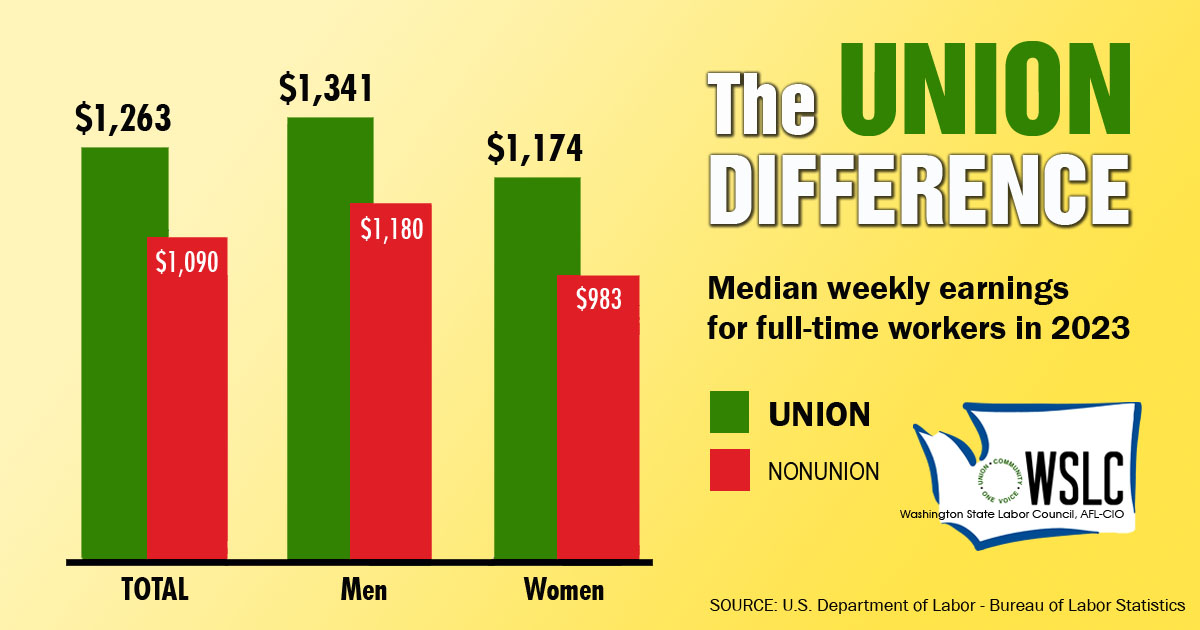
CHECK OUT THE UNION DIFFERENCE in Washington: higher wages, affordable health and dental care, job and retirement security.
FIND OUT HOW TO JOIN TOGETHER with your co-workers to negotiate for better wages, benefits, and a voice at work. Or go ahead and contact a union organizer today!